Oh, the Joys of Midlife: Apparently We're Taping Our Mouths Shut Now
Oh, the Joys of Midlife: Apparently We're Taping Our Mouths Shut Now
Dry mouth, dental health, nasal breathing, and the surprisingly real world of mouth tape.
By: Leah Burkhart
I turned 40 this year.
And apparently, this is the age when my body starts introducing new maintenance requirements without consulting me first.
Hormones? Check.
Changes in sleep? Sure.
A sudden need to think about my saliva production?
Wait. What?
I recently went to the dentist, where I learned something fascinating about myself.
Apparently, I'm a plaque builder.
Which sounds almost impressive, doesn't it?
Like I should be wearing a hard hat and supervising a construction crew.
Unfortunately, this is not the kind of productivity anyone is looking for.
My dentist started walking me through possible reasons for my plaque buildup. We talked about medications, nasal congestion, and whether sleep apnea might be contributing. There wasn't enough evidence from our conversation to point clearly toward sleep apnea, although a conversation alone can't rule it out.
Then she mentioned something else.
Dry mouth.
And suggested that I consider taping my mouth shut while I sleep.
I'm sorry. WHAT?
I thought she was joking.
She was not joking.
Apparently, this is a thing.
And naturally, I went home and investigated, because if someone recommends that I voluntarily tape my mouth shut before bed, I would like a little more information before beginning my new career as a hostage.
First, Let's Talk About Spit
I know. Riveting.
But saliva is actually one of our mouths' unsung heroes.
It helps wash away food particles, neutralize acids, and provide minerals that protect our tooth enamel. It also helps keep the bacteria in our mouths from causing too much trouble.
Think of saliva as your mouth's tiny maintenance crew.
Unfortunately, that crew already works reduced hours at night because saliva production naturally slows during sleep.
And if you're sleeping with your mouth open, things can get even drier.
Over time, chronic dry mouth can increase the risk of cavities, gum problems, bad breath, and oral infections.
Plaque is a sticky film of bacteria that forms on everyone's teeth, but a dry mouth can make it harder for our natural defenses to do their job.
So apparently, keeping our mouths moist is a legitimate health concern.
Who knew spit was such an overachiever?
Why Does Dry Mouth Become an Issue in Midlife?
There are several reasons someone might develop dry mouth, and sometimes they're working together like a tiny committee nobody invited.
Hormonal changes. During perimenopause and menopause, some women experience changes in oral comfort and saliva production. Hormones may be part of the picture, although they aren't necessarily the cause.
Medications. Antihistamines, some antidepressants, certain ADHD medications, and other common prescriptions can contribute to dry mouth.
Mouth breathing. Allergies, nasal congestion, or structural issues can make us breathe through our mouths, particularly while sleeping.
Dehydration and other health conditions. Not drinking enough fluids can contribute. Persistent dry mouth can also be associated with conditions such as diabetes or Sjögren's disease.
And then there's sleep apnea, which can sometimes contribute to waking with a dry mouth.
Women don't always experience the classic symptoms people associate with sleep apnea. Sometimes fatigue, insomnia, or unrefreshing sleep are more noticeable than loud snoring.
So if dry mouth is persistent, it's worth investigating rather than automatically blaming hormones.
Even though, let's face it, hormones have become extremely convenient suspects.
Why Is Nasal Breathing Such a Big Deal?
Here's something I found fascinating.
Our noses do more than keep our glasses from falling off our faces.
They warm, filter, and humidify the air we breathe.
Our nasal passages also produce nitric oxide, a molecule involved in important physiological processes.
And from a dental perspective, nasal breathing helps prevent the constant airflow through the mouth that can contribute to dryness.
So there's a good reason to encourage comfortable nasal breathing.
But—and this is an important but—nasal breathing being beneficial doesn't automatically mean mouth taping is safe or effective.
Which brings us back to the tape.
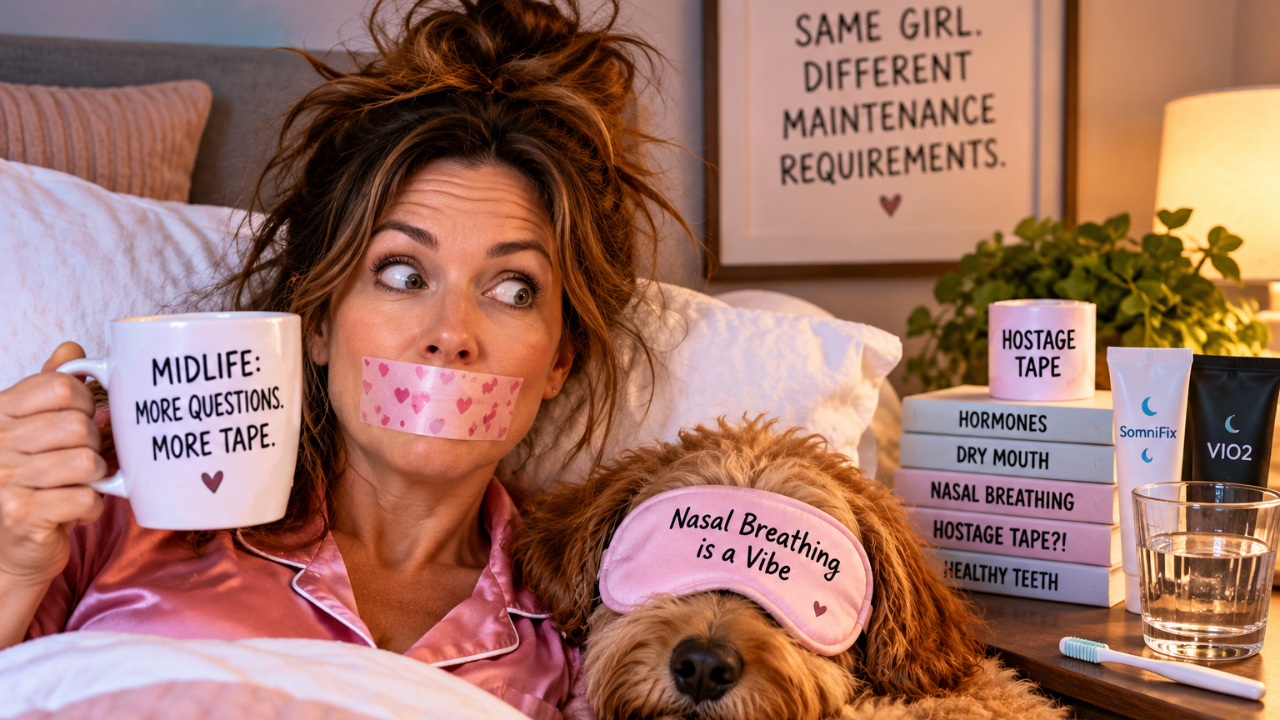
Enter: Hostage Tape
Friends, there is an actual product called Hostage Tape.
HOSTAGE. TAPE.
Someone looked at the wellness industry and thought, "You know what this needs? More kidnapping energy."
And apparently, it worked.
There are other products, too, including SomniFix and VIO2, all designed to help keep the lips closed during sleep.
The idea is simple: discourage mouth breathing and encourage nasal breathing.
Some people report waking with less dry mouth or snoring.
But here's where we need to separate an interesting idea from established science.
Research on mouth taping is still limited. A few small studies have shown possible benefits in carefully selected people, but we don't have strong evidence that it's broadly effective or safe.
And there are genuine risks.
If your nose becomes blocked during the night, taping your mouth can interfere with breathing.
It's especially important not to try it without medical guidance if you have nasal obstruction or suspected sleep apnea. Mouth taping is not an established treatment for sleep apnea.
So while the name Hostage Tape is comedy gold, I wouldn't recommend that everyone start taping their mouths shut.
The better question is: Why am I breathing through my mouth in the first place?
What Can You Do About Dry Mouth?
Fortunately, not every solution requires looking like an extra in a low-budget crime documentary.
Depending on the cause, helpful steps may include:
-
Reviewing medications with your healthcare professional or pharmacist.
-
Addressing allergies or nasal congestion.
-
Staying adequately hydrated.
-
Using sugar-free gum during the day to stimulate saliva.
-
Asking your dentist about fluoride, saliva substitutes, or other dry-mouth products.
-
Getting evaluated for sleep apnea when symptoms suggest it may be present.
And if you're considering mouth taping, talk with a qualified healthcare professional first to determine whether it's appropriate for you.
Welcome to Midlife, Where Even Saliva Has a Plot Twist
Here's what I love about this ridiculous little adventure.
I went to the dentist expecting a routine appointment.
I left with a newfound appreciation for saliva, nasal breathing, and the fact that someone has successfully built a business around a product called Hostage Tape.
But I also left with a reminder about something I talk about frequently at Phoenix Rising Family Medicine.
Midlife isn't necessarily about our bodies falling apart. It's about learning how to care for bodies that are changing.
Sometimes that means paying attention to hormones.
Sometimes it means looking more closely at sleep.
And sometimes it means discovering that your mouth has been running an unauthorized construction business while you were busy doing literally anything else.
The important thing is to stay curious.
Ask questions. Look at the evidence. Work with your healthcare professionals. And remember that not every wellness trend needs to become your next personal experiment.
As for me?
I'm 40.
I'm apparently a plaque builder.
And my dentist has introduced me to the fascinating world of nighttime mouth tape.
I don't know whether it will become part of my routine. I'm still learning about the research and safety considerations.
But I do know that if you'd told my 20-year-old self that someday I'd be writing an article about saliva production and a product called Hostage Tape, I would have had some questions.
Mostly about how things went so terribly wrong.
Welcome to midlife, my friends.
Where the body is mysterious, the learning never stops, and apparently even sleeping with your mouth open has become a topic for professional consultation.
Let's keep creating lives we don't have to recover from.
Preferably with all our teeth.
Want to Learn More?
At Phoenix Rising Family Medicine, we're interested in the many ways midlife health changes—and how we can support our bodies with curiosity, evidence, and a healthy sense of humor.
And through The Healthy Sensitive, we explore how to care for our health, navigate stress, and build meaningful lives without burning ourselves out in the process.
Because aging well shouldn't require becoming a full-time maintenance technician for your own body.
Although apparently, some days it does.
References and Further Reading
Want the Journal in your inbox?
Monthly notes on midlife health, energy, strength and aging with agency, straight from Dani & Leah, plus first access to new resources.
We respect your inbox. No spam. No selling.
We hate SPAM. We will never sell your information, for any reason.
